
What Is a Multi-Class Trademark Application?
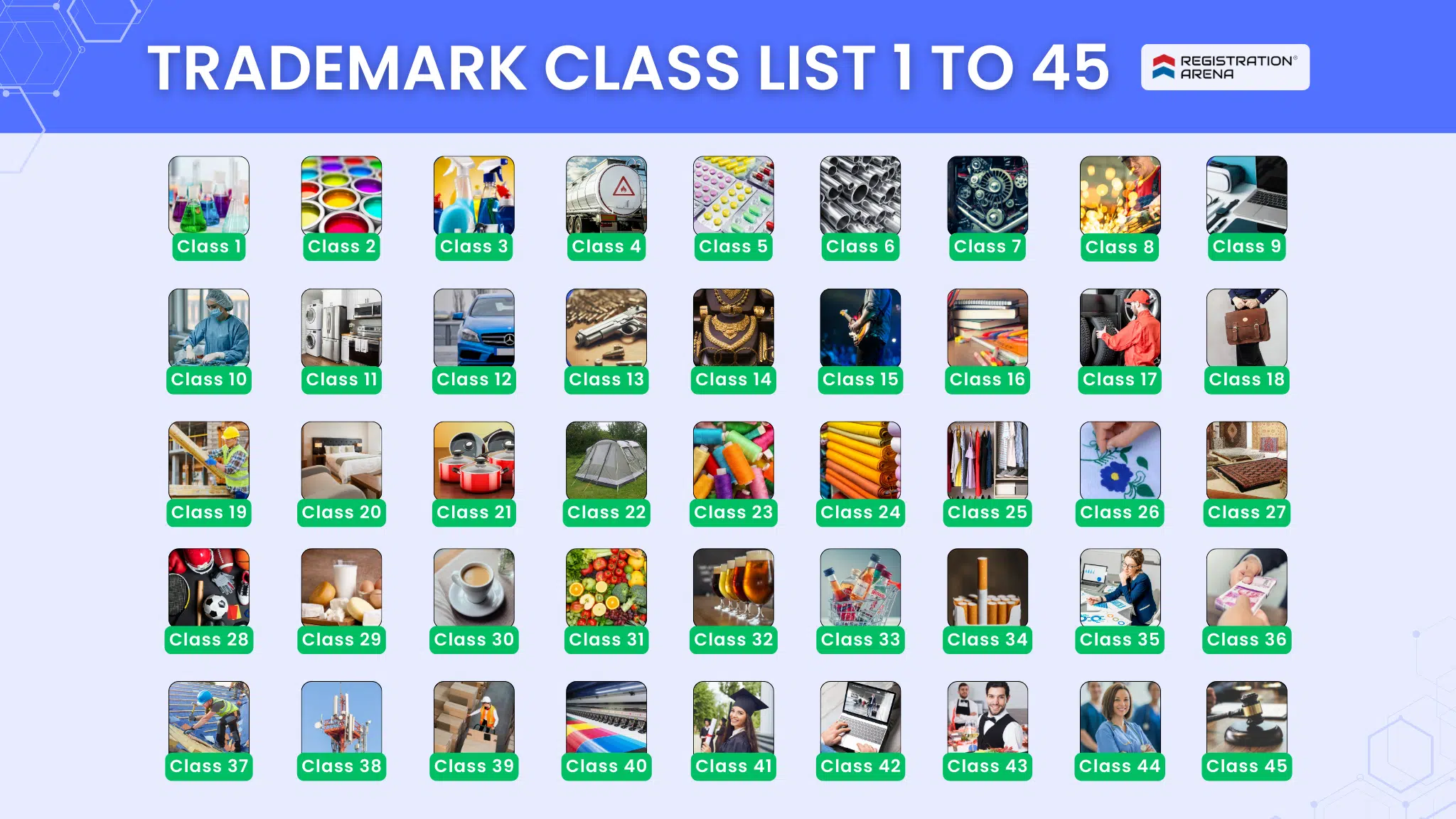
Every trademark application filed in India must be tied to at least one class of goods or services under the Nice Classification — the internationally standardised system of **45 classes** that the Trade Marks Act, 1999 and the Controller General of Patents, Designs and Trade Marks (CGPDTM) use to organise the trademark register. Classes 1 to 34 cover goods (everything from chemicals to clothing to processed foods), while Classes 35 to 45 cover services (advertising, finance, education, IT, hospitality, and more).
A multi-class trademark application is a single application, filed on a single date, in which the applicant claims protection across more than one of these 45 classes. Instead of preparing separate Form TM-A filings for each class — each with its own application number, its own examination file, and its own renewal date — the applicant consolidates the claim into one filing that lists every class the mark needs to cover.
This is a filing-mechanics choice, not a different tier of protection. A mark registered in Class 25 through a multi-class application enjoys exactly the same statutory rights as the same mark registered in Class 25 through a standalone single-class application. What changes is how the paperwork, the priority date, and the ongoing prosecution are organised — and, as we explain below, how the government fee is calculated.
Businesses reach for multi-class filing most often when a single brand name genuinely operates across more than one class from day one — a manufacturer that also runs its own retail counter, a software company that sells both a product and a subscription service, or a founder who wants one consolidated filing date covering every class relevant to the business rather than staggering applications over months.
💡 India's Nice Classification system has 45 classes in total — Classes 1-34 for goods, Classes 35-45 for services — and one multi-class application can claim protection across any combination of them.
Why a Single Business Often Needs More Than One Class
Trademark protection in India is class-specific, not blanket. Registering your brand name in Class 25 (clothing) stops a competitor from selling confusingly similar clothing under that name — but it does nothing to stop someone from opening a restaurant, a software company, or a chain of retail stores under the identical name in Class 43, 42, or 35. This is precisely why most growing Indian businesses eventually need more than one class.
The most common trigger is a business model that genuinely spans a product and a related service. A clothing manufacturer that also operates its own e-commerce storefront needs Class 25 for the garments and Class 35 for the retail/e-commerce service of selling them. A packaged food brand that also runs a chain of cafes needs a goods class (29/30/32) alongside Class 43. A SaaS company needs Class 9 for the downloadable software and Class 42 for the software-as-a-service offering. In each case, a single-class filing leaves half the actual business unprotected.
The second trigger is defensive registration — claiming classes adjacent to your core business not because you currently trade in them, but to pre-empt a copycat from registering a confusingly similar mark in a class close enough to cause consumer confusion or dilute your brand. A restaurant chain might defensively file a packaged-goods class to stop a snacks company from launching under the same name later.
Defensive filings need judgment, though: a class you never genuinely use is vulnerable to a rectification (cancellation) petition for non-use once the mark has been registered for five years and three months. Defensive classes should reflect a credible, near-term business plan — not an unlimited wish list.
Multi-Class Filing Cost: One Application, But the Fee Still Multiplies Per Class
This is the single most misunderstood aspect of multi-class filing in India, so it is worth stating plainly: there is no bundled discount for claiming multiple classes in one application. The government fee prescribed under the Trade Marks Rules is charged per class — whether that class is claimed inside one combined multi-class application or inside separate single-class applications, the total statutory outlay to the CGPDTM is identical.
For individuals, sole proprietors, and applicants who qualify as a DPIIT-recognised startup or Udyam-registered MSME, the e-filing government fee is ₹4,500 per class. For private limited companies, LLPs, and other entities that do not qualify for the concessional category, the fee is ₹9,000 per class. Claim three classes in a single multi-class application as an individual applicant, and the government fee is ₹4,500 × 3 = ₹13,500 — exactly what three separate single-class applications would cost. Claim the same three classes as a private limited company, and it is ₹9,000 × 3 = ₹27,000, again identical to filing separately.
What multi-class filing actually buys you is administrative and strategic efficiency, not a lower bill. You get one application number to track instead of several, one consolidated filing date establishing your first-to-file priority across every claimed class simultaneously, one point of coordination for responding to examination reports, and — once every claimed class clears examination and opposition — one certificate of registration listing all the classes together.
If a consultant prices multi-class filing as "cheaper," that claim does not hold up against the Trade Marks Rules fee schedule. Budget for the per-class fee, every time.
💡 Government fee is charged strictly per class — ₹4,500/class for individuals, startups, and MSMEs; ₹9,000/class for companies — regardless of whether you file one multi-class application or several single-class ones.
Worked Example: A Clothing Brand That Also Runs an Online Store
Consider a realistic scenario. A founder launches a clothing label as a sole proprietorship recognised under Udyam. The brand manufactures and sells apparel (squarely Class 25) and also operates its own website and online storefront selling that apparel directly to consumers — a retail/e-commerce service, which falls under Class 35.
Filed as a multi-class application, the founder claims Class 25 and Class 35 in a single Form TM-A filing. As a Udyam-registered individual applicant, the government fee is ₹4,500 per class, so the total statutory fee is ₹9,000 (₹4,500 × 2). One application number is generated, one filing date is stamped establishing priority for both classes on the same day, and the mark proceeds to examination as a single consolidated file.
Now compare a private limited company version of the same brand: the fee is ₹9,000 per class, so the identical two-class filing costs ₹18,000 (₹9,000 × 2) — double the individual-applicant cost, but that is purely a function of entity type, not of choosing multi-class over separate filings.
In practice, examination often does not treat both classes identically. Class 25 (a straightforward goods description) may sail through the first examination report with no objection, while Class 35 could draw an objection if the retail-service description is considered descriptive under Section 9(1)(b) or if the examiner flags a conflicting prior mark in the services register. This "one application, two classes moving at different speeds" dynamic is exactly the scenario the next two sections walk through.
How Examination Works Once You File Across Multiple Classes
Filing a multi-class application does not mean the Trade Marks Registry examines it as one indivisible unit. Internally, the examiner reviews the mark against each claimed class separately — checking the goods/services description for that class, running a conflict search against existing registrations and pending applications in that class, and assessing distinctiveness under Section 9 and relative grounds under Section 11 on a class-by-class basis. The output is a single First Examination Report (FER), but the report itself is structured to address each class individually, and it is entirely normal for it to raise no objection on one class while raising a substantive objection on another.
For an uncontested application — one where no class draws an objection and no third party files an opposition after the mark is advertised in the Trade Marks Journal — the typical timeline from filing to full registration across every claimed class is 12 to 18 months. This is the same timeline you would expect for a single-class filing; consolidating classes into one application does not slow down or speed up the CGPDTM's internal processing pipeline.
Because the priority date is what matters most under India's first-to-file system, the real advantage of multi-class filing shows up on day one, not month twelve: every class you claim is locked to the same filing date, so no one can out-file you in a class you haven't gotten around to yet. At Online Legal Mitra, we file the completed application — single-class or multi-class — within 24 hours of receiving your documents, precisely so that priority date is secured before any competitor search can catch up.
Partial Objections: When One Class Is Objected But Others Are Clear
This is the scenario founders worry about most, and it has a clean answer. When a multi-class application draws an objection on only one of its claimed classes — Class 35 in our clothing-brand example — the unobjected class (Class 25) is not held hostage by the dispute. The applicant files a response addressing the objected class, and if the registrar is satisfied, that class proceeds to advertisement in the Trade Marks Journal on its own schedule; there is no rule requiring every class in a multi-class application to advance in lockstep.
Where the objected class needs a hearing, a fresh reply, or ultimately an appeal, and the applicant wants the cleared class registered without waiting for that dispute to resolve, the Trade Marks Rules provide for division of the application. A division splits the original multi-class filing into separate applications — each retaining the original filing date and priority — so the accepted class can be carried through to registration and certification immediately, while the contested class continues its own examination or opposition proceedings independently under its new, divided application number.
Practically, this means a multi-class filing is never a single point of failure. An objection on one class in a multi-class application does not delay registration of the other classes; it simply means that, if you want the clean classes registered sooner rather than later, you or your filing agent should request division rather than waiting for the objected class to clear. This is a standard, low-cost procedural request — not a fresh filing — and it is something we handle proactively for clients whenever an FER comes back with a mixed result across classes.
Multi-Class vs Separate Single-Class Filings: Which Should You Choose?
Since the government fee is identical either way, the choice between one multi-class application and several single-class applications comes down to three practical questions.
First, timing and cash flow. If your business today genuinely operates in two or three classes and the budget for the full fee is available now, a multi-class filing is simpler to manage — one filing, one renewal cycle, one coordination point. If you are only certain about your core class today and expect to expand into a related class in a year or two, filing single-class now and adding the second class later as a fresh application is often the more sensible sequencing — you pay for what you need today, and the later class simply gets its own (later) priority date when you actually file it.
Second, flexibility to drop a class. If a business plan changes and one class is no longer relevant, a standalone single-class registration can simply be allowed to lapse at renewal with zero effect on anything else. Dropping one class out of a multi-class registration requires either paying to renew only the classes you still want, or filing for division — a manageable step, but an extra procedural layer that a separate filing never needed in the first place.
Third, risk isolation during prosecution. As covered above, an objection or opposition against one class in a multi-class filing does not block the others — division handles that. So this is not, on its own, a strong reason to prefer separate filings; it matters only if you specifically want to avoid ever having to request a division at all.
Common Mistakes Businesses Make When Selecting Classes
Class selection is where most of the strategic value — or damage — in a multi-class filing gets decided, and we see the same errors repeatedly.
Over-filing "just in case" claims five or six classes with no genuine business activity or credible near-term plan in most of them. Every extra class multiplies the government fee, and any class left unused for five years and three months post-registration becomes vulnerable to a non-use rectification petition under Section 47. Missing the paired class is the mirror-image mistake — registering the product class but forgetting the service class that actually generates the revenue, or vice versa; the Class 25 + Class 35 clothing-and-retail combination from our case study is the textbook example of a pairing that gets missed.
Vague or generic descriptions within a class invite objections — the Registry expects specific wording tied to what the business actually makes or sells, not boilerplate phrases. Misreading Class 35 for retail services is another frequent trap: Indian examiners scrutinise retail/e-commerce service descriptions in Class 35 closely, and imprecise wording here is one of the most common sources of objections in multi-class filings that pair a goods class with a retail class. Finally, assuming multi-class filing is inherently cheaper leads to under-budgeting and, occasionally, to applicants abandoning a class mid-process once the real per-class cost becomes clear.
Getting class selection right the first time avoids objections, rework, and — in the case of over-filing — money spent protecting classes the business will never use.
- 1
Over-filing "just in case" without a genuine near-term business plan for every class claimed
- 2
Missing the paired class — e.g., filing the product class but forgetting the related service class
- 3
Vague or generic goods/services descriptions that invite an examination objection
- 4
Imprecise Class 35 retail-service wording, a frequent objection trigger in goods-plus-retail filings
- 5
Assuming multi-class filing carries a fee discount — it does not; every class is charged in full
Renewals, Portfolio Management, and Filing Your Multi-Class Application
Once granted, a multi-class trademark registration is valid for 10 years from the filing date, renewable indefinitely in further 10-year terms — exactly the same validity period as a single-class registration. The renewal fee is also charged per class: ₹9,000 per class for individual applicants and ₹18,000 per class for companies. At renewal, you are not locked into renewing every class you originally claimed — if one class has stopped being relevant to the business, you can choose to renew only the classes you still use and let the others lapse, effectively right-sizing your registered portfolio every decade.
For a business with a genuinely multi-class footprint, this makes a multi-class registration easy to manage long-term: one renewal date, one certificate reference, and a straightforward decision at each 10-year mark about which classes still earn their keep.
If your business sells a product and offers a related service, or you simply want every relevant class protected under a single filing date, talk to our trademark team before you file. Visit our [Trademark Registration service page](/services/trademark/trademark-registration) or reach us at +91-8959420521 / info@onlinelegalmitra.com for a class-selection consultation.
Frequently Asked Questions
Is multi-class trademark filing cheaper than filing separate single-class applications in India?+
Can I add a new class to an existing multi-class trademark application after filing?+
What happens if one class in my multi-class application gets objected but the others do not?+
How long does multi-class trademark registration take in India?+
Should a business selling both a product and a related service file multi-class or separate applications?+
Can I drop or abandon one class from a multi-class trademark application or registration later?+
Written by
Online Legal Mitra Editorial Team
Editorial Team
Need Help with Trademark?
Get expert guidance from our professionals. Book a free consultation today!
Chat on WhatsAppRelated Articles
Continue reading with these related articles
Trademark Registration India 2025: Full Process Guide
Protect your brand with trademark registration in India. Learn about trademark classes, search process, filing steps on IP India portal, objection handling, costs, and how to secure your brand in 24 hours. Complete 2025 guide.
Read ArticleTrademark Registration Cost in India: A Comprehensive Guide for 2025
Understanding the complete trademark registration cost in India is essential for any business. Learn about government fees, professional charges, and how to save costs in 2025.
Read ArticleTrademark Classes in India: A Comprehensive Guide to the 45 Classes
Navigating trademark classes in India is crucial for brand protection. Learn how the Nice Classification system works and which class fits your business.
Read Article